
It’s a strange grief when someone you’ve never known, yet is so familiar in your life, dies. Ditto something you’ve never had, but intrinsically sense that it’s missing.
Something is thrown off kilter in that moment of news. It’s hard to know why. Spontaneous arcing takes us from where we are, to where we once were, and lands somewhere in the vicinity of becoming. I don’t think we know who the grawlix we are anymore.
Even if it constitutes the greater part of your life, there’s difficulty in remembering how the world was. How it worked prior to the likes of Zuckerberg, and that other one. And the other one after that. Over decades of learning his name, no matter what he does, Zuckerberg comes across as good and kind.
Good for nothing, and kind of an arsehole. His compulsion to take over absolutely everything is insidious.
A few years ago, he had the audacity to email Roger Waters requesting the rights to Another Brick in the Wall, Part 2 for the promotion of Instagram. Offering “a huge, huge amount of money” Waters’ short, sharp and succinct reply took just two words.
If only we’d had the foresight in 2006 to say exactly the same to that punchable face of Facebook.
The notion that without social media the world would shrink-wrap to a tiny, airless place of just you and the people with whom you physically interact, is delivered like the Brothers Grimm unearthed. A damned and futile peasant life. Constrained and constricted by family, friends, co-workers and those keenly enjoying the same social and sporting activities.
What.Unimaginable.Horror.
It’s a flagrant fallacy of argumentum ad ignorantiam. No matter how many people or groups interact online, there’s little genuine communication. Nor does it deliver the authenticity of a broader life. It’s the illusion of doing more with phantom others: a veritable Barmecide feast. The actual ‘doing’ is substantially less. With a whole lot of others equally doing less. The only emotional investment is what everyone makes up in their head.
The image that’s given of the world BCE (before cyberspace encroached), is that people were devoid of any kind of knowledge or interest beyond what was caned into them at school, or absorbed within a five kilometre radius from where their parents were conceived.
What appears completely overlooked are the books that were devoured, the eclectic album collections bought and shared; the regular parties, dinner parties and unprompted get-togethers. Movies were watched at the cinema with more than just you. Nights were for the rhythmic moving of your body in a club, at a live gig or with someone else naked. Cattle, not people had brands. Conversation was an art form. Experiencing a different place or another country took more than a doco – you went there. Almost everyone played a sport, had hobby or honed an artistic skill. Regardless of how obscure, finding information meant browsing the library’s Dewey Catalogue System cards that cross-referenced better than any browser ever does, and the likes of Meghan Markle et al were in the depths of nowhere where they belong.
Life being about the journey rather than the destination rang truer. Anticipation and organisation took more than tapping a card, and longer than scrolling an app.
It wasn’t nirvana; there is no such place – but the stress of content wasn’t being lost in the wasteland of a digital landscape, it was on the second syllable. Stupidity, egotism and pretension had fewer applauding bystanders. Privacy existed. There was more empathy and less emotional fragility. Anonymity didn’t need to be a business model. All you could post was mail; and the only outside validation you sought was for free parking.
We have become caged by thought, and cagey about what we think. Until we find a reflecting pool vast enough, of irrelevant depth. The high currency of our own thoughts is self-proclaimed without self-examination. Diverse weights are attributed to the worth of what others think.
It’s instinctive now to denigrate anything logic cannot touch.
Which is everything. Absolutely everything.
Everything is alive and living and full of mystery, and we willingly and rapidly deprive ourselves of all of that. We consider ourselves more important than the life force around us to enable the constant and continual destruction of it. Even when we see the results and know how to repair and replenish it, we simply acknowledge that and do nothing.
Why? Why do we do that? Why do we constantly bullshit ourselves about the state of the world and our place in it? Truth has not only taken a backseat, it’s the backseat of a bendy bus with all the stops unilaterally cancelled after everyone got on.
We are so enamoured by the idea of how incredibly powerful thinking is – no matter how feeble – we commit only to that which is effortless. In doing that, the momentum of action is lost. It’s action that imprints meaning.
Don’t be all affronted and insulted by whirring thoughts of how much effort you’re always putting into everything. And don’t imagine that at the actual moment the above paragraph was written, a monocle dropped into a baluster glass of sherry. We’ve created addictions to comfort, convenience and petty competitiveness.
That perception of effort is an assumption based on the feeling of constant exhaustion. It’s a fatigue due to complication of the simplest tasks, amid landmines with the potential to trigger the surface emotions bubbling away in pretty much everyone. It’s largely the reason the majority of interactions are unspeakably reduced to text, emojis, labelling, victimhood and ghosting.
This preference for the nonverbal, means that the 93% of quality human communication – the body language, vocal tone, emphasis and nuance – isn’t there. Misinterpretation is frequent. The common way to deal with this (often reciprocal) confusion, is a volley of textese or maybe one or more of 3,954 available emojis. Not getting anywhere? Then block them. Or cut out the digital deluge altogether and just ghost them.
What was once a noun is now also a verb.
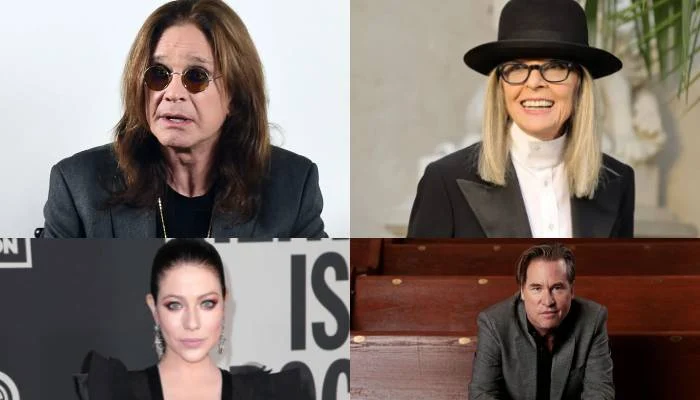
Ozzy Osbourne is now the noun. The remarkably resilient and resistant ‘Prince of Darkness’ was both a demon and a god. Altruistic, complex and openly flawed. A tender-hearted screwball of fierce family love and friendship, this cardinal of heavy metal and hard rock leaves a legacy spanning almost 60 years.
Similarly, is the indelible cinematic mark of the versatile Diane Keaton. Her comedic timing seamless; her mastery of the casually neurotic unsurpassed. Although the quirky, iconic, Annie Hall remains one of her most memorable, it’s a movie unlikely to be post haste embraced by the ghosting text set. Primarily, it’s people talking. Just talking. Walking and talking, talking over lunch; talking to their shrink. It has monologues, voice overs and internal thoughts. And when there’s no-one to talk to then break the fourth wall. It’s not made of brick.
We know everything, and nothing about either of these once flesh-and-blood people. The strong and lasting impression is the fearless creativity in both: and how brilliantly human they were. Each leaves a colossal borehole in a current culture so desirous and driven toward conformity, that the second richest person on the planet thinks that the only thing that inspires, is money.
There’s something intrinsically missing.